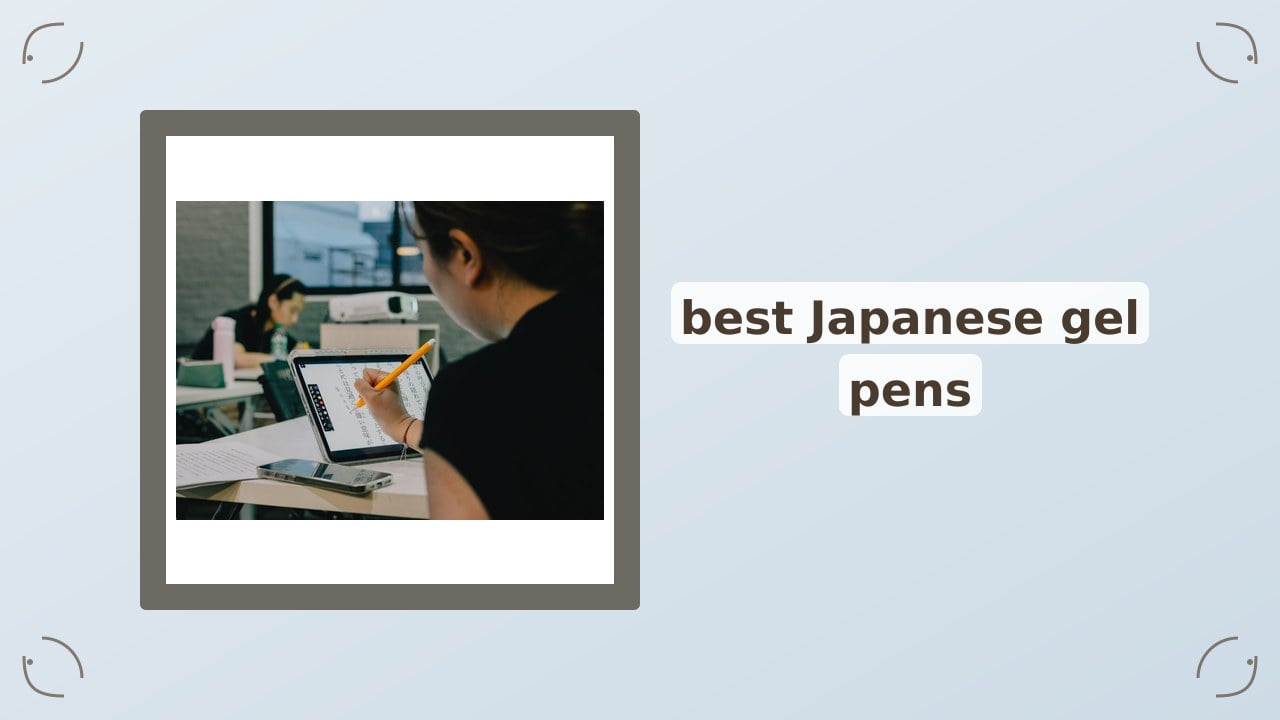
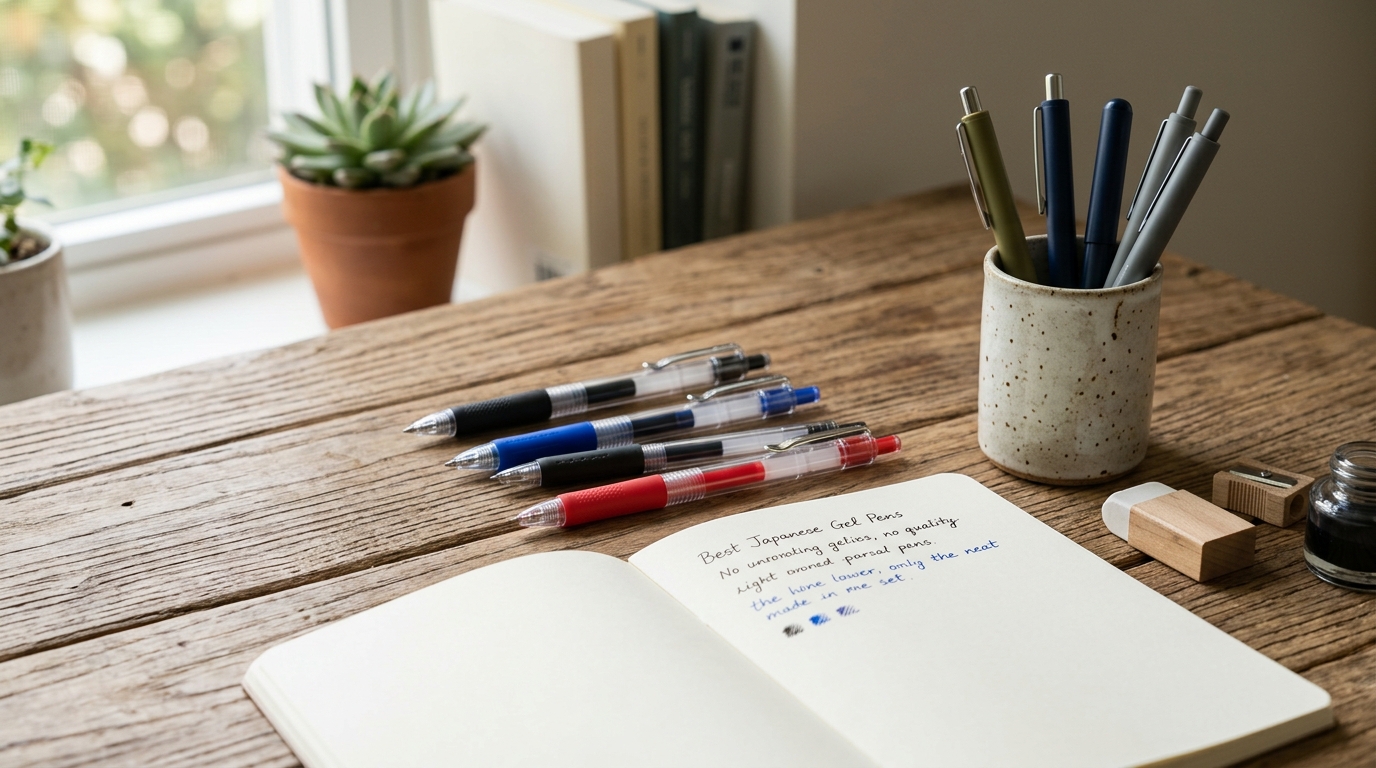
At $1.80, the Zebra Sarasa Clip is still an easy pen to reach for in 2026. Its plastic body keeps things uncomplicated, and the smudge-proof ink tackles a familiar gel-pen problem, especially for left-handed writers. The current “Buy 3 Free 1” promotion also makes stocking up more practical.
Want more weight? The redesigned Zebra Sarasa Grand is worth a look, particularly because it fixes the earlier clip interference issues.
For most writers, the Zebra Sarasa Clip remains the safest bet. Its ink dries fast, so left-handed writers and anyone taking hurried notes won’t drag wet lines across the page. The barrel isn’t flashy, but that’s hardly the point.
At a glance: Best Japanese Gel Pens
|
Pen Model |
Best For & Key Detail |
|---|---|
|
Zebra Sarasa Clip |
The smudge-proof standard for lefties; widely available with a “Buy 3 Free 1” promotion in August 2026. |
|
Pilot Juice+ |
The latest March 2026 release featuring a frosted barrel, synergy tip, and new floral ink shades. |
|
Pentel EnerGel Infree |
The top-ranked student model of 2026, favored for its clear barrel aesthetic and fast-drying liquid gel. |
|
Zebra Sarasa Grand (2024) |
A premium metal flagship redesigned to be 5g lighter with a lower clip to prevent hand interference. |
|
Muji Smooth Gel Ink Pen |
A budget-friendly option ($1.50) with a redesigned system ensuring all refills work across capped and click bodies. |
Zebra Sarasa Clip: The Reliable Daily Driver
The Zebra Sarasa Clip isn’t the flashiest pen on the desk. Still, at $1.80 per unit, it lands in a useful middle ground between price and quality, which is why students and office workers who burn through pens keep coming back to it. Its consistency, more than its looks, is the real selling point.
Why the Sarasa Clip remains a budget favorite
Reliability starts with the small details. The clip tolerates daily backpack abuse, and the textured grip helps keep the pen steady through long writing sessions without turning cheap or sticky in your hand.
There’s another practical advantage: refills cost $1.10. When the ink runs out, you can replace the refill instead of the barrel, an option that’s still unusual among budget pens because buying an entirely new one is often simpler.
How the August 2026 Buy 3 Free 1 promotion works
The timing is especially useful if you need more than one. Through August 2026, the current “Buy 3 Free 1” promotion lowers the cost per pen to $1.35.
-
Pick several colors and test which shades actually suit your note-taking system.
-
Give the free pen to a colleague or classmate, splitting the savings instead of letting it sit unused.
-
While the promotion is running, add black and blue refills to your stock.
Major stationery retailers and online outlets carry the deal, so you won’t need to track down an obscure shop. It’s a straightforward volume discount, not a puzzle involving coupon stacking.
The benefit of standardized smudge-proof ink
“Smudge-Proof” is how Zebra markets the line, and the claim targets gel ink’s familiar weakness: drying time. The ink still doesn’t set as quickly as a ballpoint, but it dries fast enough to head off most accidental smears, including the kind caused by left-handed writers or hurried page-turning.
Nothing major has changed in the model during the last 12 months. Last year’s pen should write like today’s, which keeps both the feel in hand and the expectations pleasantly predictable.
Pilot Juice Plus: The Fresh 2026 Contender
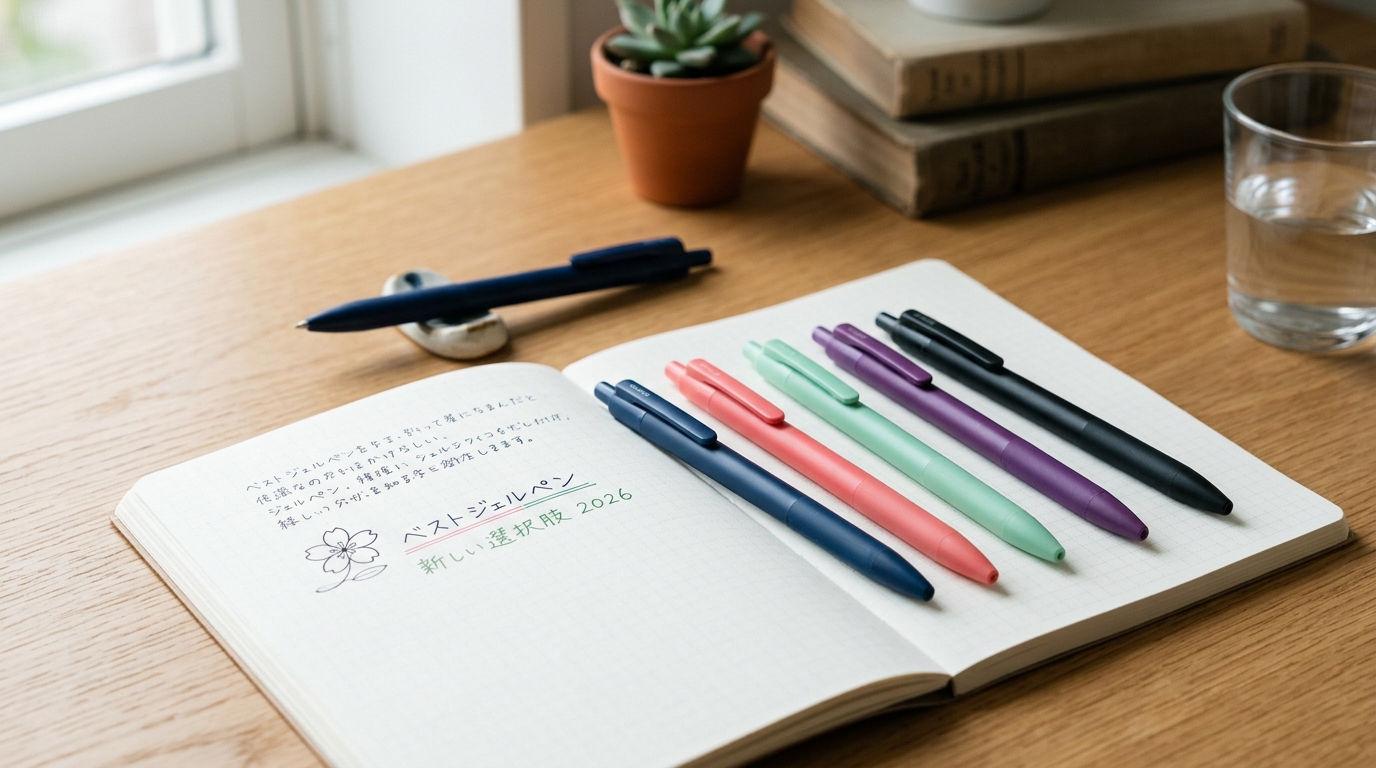
Pilot released the Juice+ in March 2026 at roughly $2.00 each. It sits between the standard Juice and the premium Juice Up, but this isn’t a repackaged older model. Instead, the pen targets writers who want hybrid ink’s smoothness without paying for the metal accents found in higher-end lines.
How the March 2026 update changes the series
The earlier Juice lineup had too many overlapping models. Casual buyers could easily get stuck comparing pens that felt nearly interchangeable. Juice+ gives the 2026 range a more obvious middle option, with greater comfort than the basic Juice and a lower price than the Juice Up.
Pilot also refined the grip section after user feedback from late 2025. During longer writing sessions, it puts less strain on the fingers, while the slightly forward balance point gives you better control without making the pen feel top-heavy. The difference is modest.
Daily journaling feels more comfortable because of it.
Frosted barrels and floral ink colors
The exterior gets the most immediate makeover. Earlier glossy plastics give way to soft-touch frosted barrels, which feel more premium in hand and make the pens look less like student stationery. Muted pastels replace the neon colors used in earlier student-focused releases.
-
Frosted clear bodies show ink levels while hiding scuffs.
-
Floral-inspired colors such as “Sakura Mist” and “Lavender Haze” offer subtle shading.
-
Color-coded clips match the barrel for a monochromatic look.
It has personality, but not so much that it feels out of place in an office. That balance makes Juice+ practical for quick notes and signing documents, especially when the pen will be visible.
Performance of the new Synergy Tip technology
Pilot says the new tip reduces skipping on low-quality paper, and standard copy stock supports that claim. Ink flows consistently from the first stroke, so you won’t need to scribble in the margins to wake it up, a common annoyance with cheaper gel pens.
On smooth paper, drying time remains competitive at around three seconds. Glossy surfaces expose one limitation: the pen is slightly slower than Zebra’s Sarasa. For meeting notes, lists, and letters, it dries quickly enough to prevent smudging for right-handed writers.
Left-handed writers may still want to pause briefly after long strokes.
Uni-ball One P: Compact Power in Premium Colors
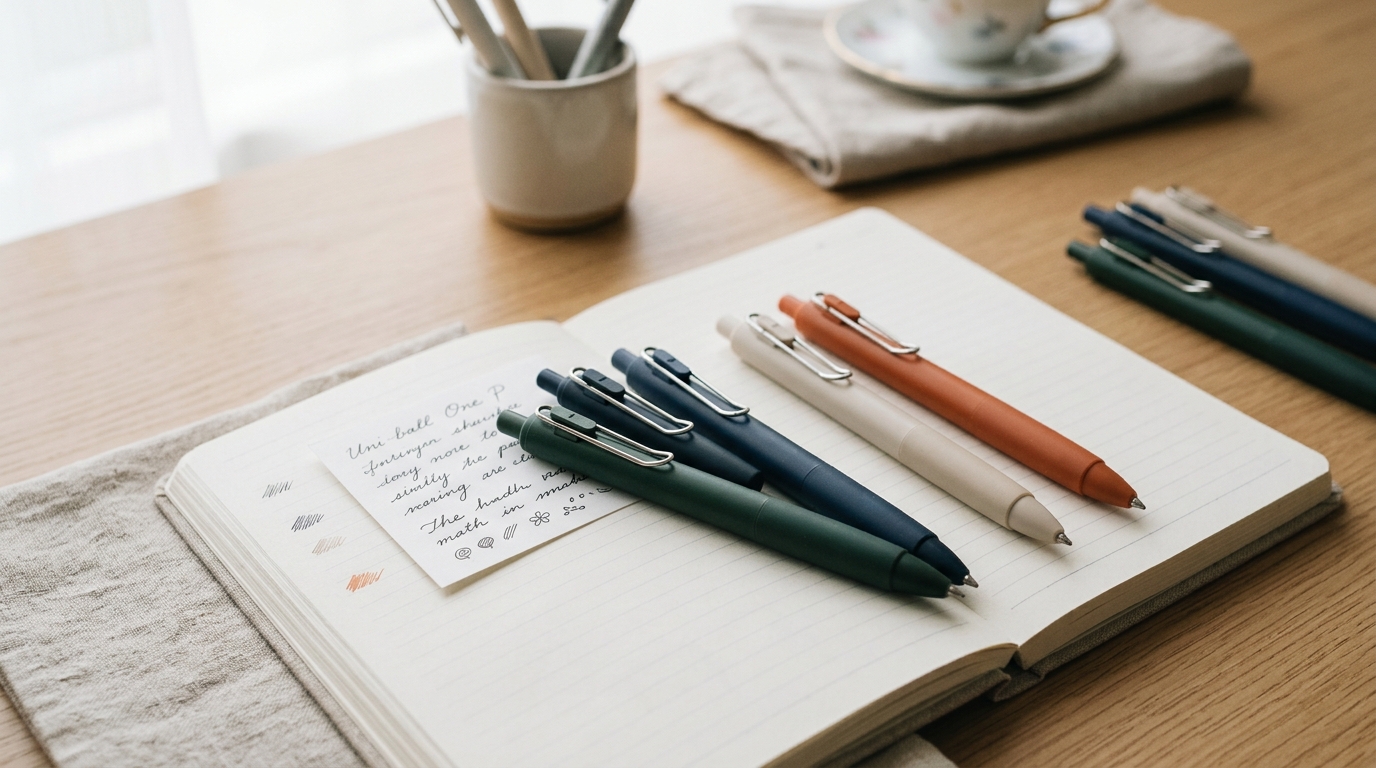
At roughly $4.50, the One P costs more than double the standard model. Still, it keeps earning space in pencil cases because its physical footprint is so different. The barrel is shorter, which shifts the balance in your hand and gives the grip a reassuring heft without making the pen cumbersome.
The advantage of the short chubby barrel design
“P” stands for pocket, although portability is the more useful advantage here. The body gets shorter while its girth stays put, pulling the center of gravity closer to the tip. That means you don’t need to choke up on the barrel when you’re taking detailed notes or writing small.
Long, lightweight pens can wobble. This one doesn’t as much.
Its compact body feels planted against the paper, potentially easing hand fatigue during long writing sessions. The size also makes sense in cramped places. On a train or at a crowded cafe, the pen is less likely to catch on your sleeves or snag a notebook.
Exploring the unique Yogurt, Banana, and Grape shades
Black and blue remain workhorses, but the 2026 color expansion gives the page more personality. “Yogurt” isn’t simply pale yellow. It’s creamy and soft, yet still clear on white paper, without the sharp glare of a neon highlighter.
-
Banana: A warm, muted yellow for subtle annotations.
-
Grape: A deep, rich purple with high contrast that doesn’t look like standard blue.
-
Yogurt: A soft shade for color-coding without overwhelming the text.
There’s an important change here: these are no longer limited Expo 2025 editions. They’re now part of the core lineup. Fast drying and fade resistance make them useful in journals, where visual appeal matters almost as much as legibility.
When to upgrade from Standard One to the SP model
The standard One costs $1.90 and makes a strong case for bulk buying. Its finish, however, doesn’t have the refinement of the SP. If pens routinely disappear from your desk, or colleagues tend to walk off with anything left within reach, the standard version is probably the sensible choice.
For anyone who notices tactile feedback, the SP feels more like a dedicated tool than a disposable item. Its matte coating gives your fingers a steadier hold, while the premium colors make the upgrade visible without shouting about it. It’s a small luxury, admittedly, but that little bit of ceremony can make daily writing feel less like a chore.
Zebra Sarasa Grand: The Premium Metal Experience
At $10 to $13, it may be too expensive for casual buyers. Still, the 2024 Vintage Renewal redesign fixes the flaw that made this flagship model frustrating to use. The pen remains a handsome metal tube, only now it sits far more comfortably in your hand.
Impact of the 2024 Vintage Renewal redesign
Zebra changed more than the colors. The company removed 5 grams from the body and moved the center of gravity forward, which gives you steadier control through long writing sessions. The earlier version was top-heavy and sluggish.
It felt like dragging a small weight across the page.
This lighter chassis makes a real difference. Fatigue drops, and the pen becomes practical for exam halls and marathon note-taking instead of serving mainly as a desk display. That’s the useful part of the redesign.
Its retro appearance hasn’t disappeared. The pen still suits anyone drawn to the tactile feel of mid-century office supplies, while its metal construction helps it stand apart from plastic clips without shouting for attention. If you’re tired of stationery that feels disposable, the reduced bulk answers one of the clearest complaints about the older model.
How the lower clip position improves writing comfort
The comfort upgrade is easy to miss until you write for a while. Zebra placed the clip lower on the barrel. On older metal pens, a high clip can dig into the webbing between your thumb and index finger, and after twenty minutes that pressure can become painful.
Lowering the clip removes the trouble spot. You can keep a natural hold instead of reshaping your grip to dodge the metal, while the pen continues to support a relaxed tripod grip. Hand cramps are less likely during extended writing, and you won’t need to learn a new writing style.
Does the metal build justify the higher price?
The question is whether a body costing over ten times as much as a standard Sarasa Clip earns that premium. In practical terms, the aluminum barrel is more durable than plastic and can survive drops that would crack cheaper resin barrels. It also feels substantial in a pocket without becoming ostentatious.
There’s another modest advantage. The refills remain compatible with standard Sarasa ink ($1.10), so the extra money goes toward a longer-lasting body and a more satisfying object in the hand, not an entirely separate ink system.
-
Durable aluminum construction resists daily wear and tear.
-
Balanced weight helps reduce hand fatigue.
-
Limited edition colors offer more personalization options.
Pentel EnerGel Infree: The Student Choice for Speed
Exams move quickly. The Pentel EnerGel Infree keeps pace, laying down ink that sets almost before it reaches the paper. For students who write fast and can’t stand smudges, that difference shows up immediately.
Why the clear barrel design ranks highly with students in 2026
You can see the ink level through the transparent body, so there’s no need to guess when the supply is running low. The barrel also stays light and balanced, which becomes important during a three-hour essay when a heavier metal pen can start to feel tiresome.
The fast-drying advantage of liquid gel ink
Some gel ink lingers on the surface. A passing palm can drag it across the page. EnerGel’s liquid formula dries quickly instead, a useful trait for left-handed writers and for anyone who presses hard while writing.
-
Dries quickly on standard copy paper
-
Resists smearing when pages are flipped quickly
-
Maintains a consistent flow at high writing speeds
The result is a cleaner page. Because the ink bonds to the paper fibers quickly, answers stay legible from the first word to the last.
Comparing Infree value with standard EnerGel-X
Standard EnerGel-X is excellent. It also costs more, and its packaging often adds little for school use. Infree puts the emphasis back where students usually need it: on the pen’s core performance.
You still get the same rapid-dry technology, but at a lower price. Buy enough pens for a whole semester and those small differences accumulate. For students who write often, function matters more than appearance.
There’s one qualification. If you don’t need a clip or a rubber grip, this model offers better value per milliliter of ink. Nothing fancy, just a straightforward classroom pen.
How to Choose the Right Japanese Gel Pen for Your Needs
Left-handed writers know the problem: a clean page, then a fresh smear across it. That’s why quick-drying ink deserves attention before color or price when you’re choosing a pen, especially among Japanese manufacturers that focus on fast-setting formulas.
Evaluating ink dry time and smudge resistance
Test it yourself. Write a line, wait three seconds, then drag your thumb across the mark. A blurred line signals trouble for rapid note-taking or left-handed writing, although the fastest formulas may sacrifice a little color vibrancy compared with wetter, slower-drying ink.
Standard gel ink rests on the paper surface for a few seconds before setting. If your hand follows closely behind the pen, look for “smudge-proof” wording, including the label used for the Zebra Sarasa Clip. These inks absorb into the paper fibers almost instantly.
Understanding tip sizes and line consistency
Tip diameter changes both precision and ink flow. A 0.38mm point can handle small grids neatly, though rough paper may make it feel scratchy. For everyday journaling, 0.5mm remains a comfortable middle ground.
-
0.28mm to 0.38mm: Best for dense technical notes or kanji practice.
-
0.5mm: A reliable choice for legible, smooth writing.
-
0.7mm to 1.0mm: Ideal for bold headings or quick signatures.
There’s a cost to going wider: larger tips lay down more ink, producing darker lines but increasing the chance of smudges. Choose 0.5mm when you want speed and clarity without frequent blotting.
Balancing grip comfort with barrel design
Grip comfort tends to stay out of your thoughts until a long lecture brings on cramps. Rubberized grips add traction, but lint can gather on them and the surface may wear down over time. Smooth plastic barrels, like those on the Uni-ball One P, stay cleaner, yet sweaty hands may find them slippery.
Metal-bodied pens bring better balance, but their extra weight can tire your fingers during extended writing sessions. For students, a lightweight plastic pen with a contoured shape is often a better companion than a heavier premium model.
Conclusion
Your paper matters. So does your pace. Try one Zebra Sarasa or Pilot Hi-Tec-C in your notebook first, especially if you write quickly, because that small test can spare you more regret than another online review before you buy a pack.
